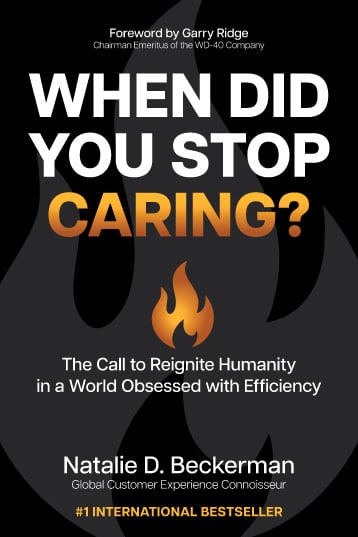
When Did You Stop Caring?
The Call to Reignite Humanity in a World Obsessed with Efficiency
Known as The Global Customer Experience Connoisseur, Natalie Beckerman is an internationally recognized titan in the world of customer experience.
Her new book, When Did You Stop Caring? offers a seasoned analysis of customer service strategy triumphs and failures, as delivered by organizations large and small. Throughout, she refutes the lie that “caring” is soft and instead explains how when done right, represents a disciplined, profit-driven approach to customer service. In myriad ways, Natalie reminds leaders that they do business with people, not spreadsheets.
More importantly, she paves the way forward, outlining how to deliver better customer service outcomes. Discussing lived use cases from her own life and expansive career, she illustrates how empathy and efficiency can go hand in hand.
Diving deeper, Frost & Sullivan, The Transformational Growth Company, ® recently posed the following questions about When Did You Stop Caring? to Natalie. Read on for her insightful responses.
The Caring Recession
Frost & Sullivan: Your new book, When Did You Stop Caring,? opens with a discussion about the “caring recession,” a key reason you wrote the book. Can you briefly discuss this concept and why addressing it is critical to better customer service?
Natalie Beckerman: No one just wakes up one day and stops caring. We’re experiencing a Caring Recession. We have moved way past what we used to refer to as a crisis. The Caring Recession is not some poor quarterly performance or simply a rude employee – it’s a sustained structural withdrawal of human care from organizations at scale. You can recover from a crisis; a recession reshapes expectations forever. I called it a recession on purpose, because, like an economic one, it compounds overnight before anyone names it. Customer Service is where it’s felt first and worst because that is the front door of the whole enterprise. Unless we give it a name, then we won’t be able to start reversing its effects. By naming it we can begin the journey to bring the human lens back in balance – and we can start to care on purpose again.
Culture and the Middle Layer
Q: In Part 2, you discuss how important culture is to a company’s success. You zero in on the importance of the middle layer. Can you elaborate? Any insights to help middle managers caught between C-Suite directives and challenged customer service teams?
A: Culture is not created by the executive level, nor is it lived at the top. It is passed through the middle. The C-suite creates the policy, but middle management will determine whether the policy is actually implemented. Therefore, I always call culture a base or foundation, not a sign or a poster. Middle Management sits on the fault line: executives sending orders down from the top, overworked staff members looking up, and everyone assumes middle management will simply take the heat off. We need to stop using middle management as a “relaying” point where pressure flows downward from upper management and begin viewing middle management as the ones who can provide air coverage to do the right thing. A successful middle manager translates for their team, determines how policy affects the customer in front of him or her, and provides support so their employees can make the correct decisions.
Operationalizing the Mission
Q: Operationalizing the enterprise mission statement (rather than just messaging around it) through the actual policies, procedures and actions of employees is another key concept in your book. How do you put this into practice? Any guidelines on how to make your company’s philosophy a lived reality for customers?
A: The space between a business’s claimed beliefs and the real-life experience of a customer is called the “Caring Gap.” Typically, the Caring Gap is filled with good intention and poor policy. An internal statement regarding a company’s belief system or their mission communicated as a message to customers is an example of a mission statement; however, when that same mission statement is embedded into a company’s operational practices, it becomes an example of a mission being lived.
To close the Caring Gap, I suggest that company leaders review every policy they have created and ask themselves if that particular policy supports their employees’ ability to provide better service to customers. Does it create barriers for their employees? Next, identify the times when team members are forced to make a decision regarding whether they should follow procedure, or do what is right for your customer at that moment, because during those moments your team members are testing your stated mission and discovering what you truly believe. Provide your team with the authority to use their own discretion in making decisions for customers. This is the Human Standard. It is not a marketing slogan that you can merely announce; rather, it is a measurement standard that you must live up to in all your operational activities.
The Business Case for Caring
Q: In Part 4 you present the “business case for caring” — why is this important? How does caring affect return on investment? How does automation factor in?
A: Caring is not soft. It is economics. I wish more finance teams understood that. Loyal customers are cheaper to retain than to get back, they spend greater money over time and forgive you when you stumble – those are return on investment (ROI) statistics and sentiment.
Sheila (the name of my car) that was returned, made me a loyal customer of a brand for years because that brand didn’t argue with me about fixing my issue. Instead, they gave me their standard service which went the extra mile.
The turnover you avoid when your employees feel valued is ROI too. Every person who stays is one hire you didn’t have to make twice.
Automation is not the villain here. It’s indifference. Used properly, automation removes friction and drudgery so your people can be free for the moments which truly require a human — complicated, emotional, or the kind that people will remember. The failure is when we remove these very moments from our people by using automation to save small amounts of money.
Care is what compounds. Everything else is just cost management disguised as strategy.
Efficient versus Built to Last
Q: Can you distinguish between a business that is very efficient/profitable versus one that is built to last? How does the organizational mindset differ? Any practical applications you can point to?
A: Efficiency is an important goal for companies; however, there is a difference between efficiency and being “built to last.” When organizations focus solely on being the most efficient, they may achieve short-term goals such as low costs or high profit margins. However, by focusing solely on how to lower their costs (i.e., eliminate non-essential jobs) while maintaining productivity, these organizations will ultimately fail.
Companies that have long-term goals tend to focus on building strong relationships with their customers, and therefore, the quality of service will be higher. Additionally, employees who work for companies that build long-lasting customer relationships are often rewarded, which also creates employee loyalty. As a result, employees become the greatest asset of a company. Trust also becomes an important component of a successful business. Building trust takes time and effort, but when achieved, it helps create long-lasting relationships with both employers and customers. Therefore, businesses that treat employees as assets and view trust as capital will be able to develop sustainable growth.
The Beckerman Caring Challenge™
Q: Your book closes with “the Beckerman Caring Challenge” — a 12-month commitment to restore and reignite humanity. No small feat! Can you share a few key action steps with our readers?
A: A twelve-month plan seems overwhelming at first. The Beckerman Caring Challenge™ is a 12-month, 4-quarter roadmap to take your beliefs and transform them into tangible and observable leadership behaviors by putting your values into action.
You can begin wherever you’d like within the four quarters of the Challenge. Just get started. The Challenge was designed to create habits. Here are a couple of examples of the foundational elements I would consider starting with:
First, complete an objective assessment — identify your Caring Gap before announcing a single new project or program. You cannot address what you’re unwilling to acknowledge.
Second, establish a handful of commitments that will be non-negotiable, and then display them as such. Good intentions have a low success rate when it comes to actual completion. What holds people accountable to their commitments is “caring out loud.”
Third, schedule accountability on the calendar once each month — one intentional opportunity per month for leaders to ask themselves, “In which areas did we demonstrate caring? In which areas did we fail to care? What are we going to change?”
Accountability is what differentiates a value from simply being a feeling or vibe. And running underneath all of it is what I call the Flame Forward: the idea that reignited humanity isn’t something you keep, it’s something you pass on. Do this for a year and you don’t just improve your metrics; you change what kind of company you are. And you bring the lenses of humanity and efficiency back in balance and back together.
Don’t Miss Natalie at Customer Contact West
Natalie Beckerman will be hosting a CX Women’s Leadership Alliance Workshop at the 22nd Annual Customer Contact West: A Frost & Sullivan Executive MIndXchange in Tucson, Arizona from October 18th to 21s.t. The event will take place at the JW Marriott Tucson Starr Pass Resort & Spa and the Women’s Workshop, themed Owning Your Growth Journey, will take place on Sunday, October 18th at 2:15pm. Learn more here.
Described as a fixer in the customer experience and customer contact space, Natalie Beckerman has run top tier, large scale operations driving transformation and change, leading strategy, while conquering operational and service excellence across the Globe. She is known to build new business, increase revenue and turn around performance, while at the same time reenergizing and invigorating businesses and leaders. Natalie has done this in the telecommunications/mobile, Home Services, Hospitality and Fintech/Financial services industries.