
In today’s competitive landscape, organizations have access to more customer data than ever before. Advanced analytics, Artificial Intelligence (AI), Voice of Customer (VoC) ecosystems, Customer 360 platforms, and behavioral intelligence have dramatically expanded the scope and frequency of customer insights across the enterprise. However, collecting data alone is not enough.
The real strategic advantage comes from transforming data into actionable insights that inform better decisions, build trust, and enable sustainable growth. Enterprise Customer Intelligence™ provides a framework for organizations to leverage customer understanding as a key strategic asset – positioning them ahead of competitors to secure long-term success.
This creates a paradox: despite abundant customer information, enterprise capabilities often remain fragmented. Insights are generated across various functions but are rarely integrated into a unified model that supports decision-making, governance, and trust.
The Need for Enterprise Customer Intelligence
Organizations need to move beyond isolated feedback programs and siloed data. The goal is to develop a comprehensive, real-time, integrated, and actionable understanding of customers. The Model provides a framework to achieve this by linking customer insights, decision-making, and governance to improve organizational performance and foster customer trust.
For CX and contact center leaders, the practical test is whether customer intelligence is being used to improve service design, reduce friction, and make faster, more informed decisions during moments that matter.
The Enterprise Customer Intelligence Transformation Model
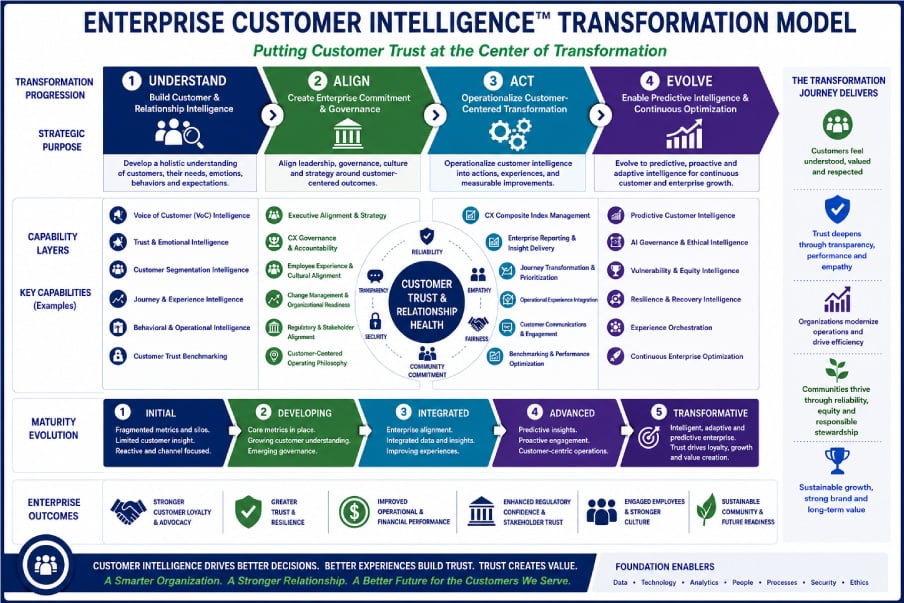
This model converts customer signals into improved enterprise decisions. It underscores that customer trust and relationship health are vital indicators of whether these decisions strengthen relationships and create lasting value.
The model is built on four interconnected capabilities that progressively turn customer understanding into enterprise-wide intelligence, stronger trust, and sustainable success:
- Build Unified Customer Understanding
Achieving a unified view of the customer requires transcending isolated surveys and feedback. Integrating Voice of Customer data, behavioral analytics, operational data, journey insights, and Customer 360 information provides a real-time, holistic picture of customer needs, expectations, and emerging friction points.
- Align Intelligence with AI and Decision-Making
Customer intelligence adds value when it directly informs decisions. AI enhances this by processing large data volumes, identifying patterns, and generating predictive insights. Leading organizations leverage AI not only for customer service automation but also for strategic planning, risk detection, investment prioritization, and performance management. The strategic advantage lies in translating insights into actionable improvements.
- Operationalize Intelligence Through Better Decisions
Embedding customer insights into decision processes transforms customer intelligence into an enterprise capability. Decision intelligence integrates understanding into functions, such as finance, operations, product development, marketing, customer service, and strategic planning. This approach enables organizations to evaluate trade-offs more effectively, prioritize initiatives, reduce friction, and align actions with customer needs and business objectives.
- Strengthen Trust Through Governance
As AI and predictive models become central to operations, robust governance is essential. Trust-centered governance requires clear standards for transparency, privacy, ethics, and responsible AI. Demonstrating responsible data management and model use fosters customer trust and aligns organizational practices with ethical standards and customer expectations.
From Insight to Enterprise Value
To realize true value, customer intelligence must extend beyond insights teams and marketing functions. It must influence decision-making across the C-suite and throughout the organization. When integrated – combining understanding, AI, decision intelligence, and governance – organizations can:
- Reduce Enterprise Risk: Better identify friction points, compliance issues, emerging risks, and vulnerabilities early, reducing operational disruptions and reputational damage.
- Improve Enterprise Performance: Use customer insights to allocate resources more effectively, enhance efficiency, and prioritize high-impact initiatives.
- Strengthen Long-Term Value: Protect customer data, communicate transparently, and deliver experiences aligned with customer expectations – building loyalty, increasing lifetime value, and enhancing resilience and competitive positioning.
Strategic Implications
The next competitive advantage will not rely solely on data volume or AI sophistication. Instead, it depends on an organization’s ability to translate customer understanding into decisions that drive measurable outcomes. Enterprise Customer Intelligence – by integrating insight, AI, governance, and decision-making – shifts the focus from merely understanding customers to actively enhancing decisions, building trust, and creating long-term value.
For executive teams, the critical question is not how much data is available, but whether customer insights influence decisions that strengthen trust and relationships over time. Organizations that excel at this will differentiate themselves through stronger execution, more responsive decision-making, and enduring customer relationships.
By adopting Enterprise Customer Intelligence as a strategic capability, organizations can harness the full potential of their customer data – driving innovation, resilience, and leadership in their markets. Prioritizing this transformative methodology becomes essential for organizations seeking sustained competitive viability.
John Bord is a seasoned customer strategy executive, consultant, and thought leader with over 25 years of experience in Customer Experience (CX), Customer Intelligence, Voice of the Customer (VoC), strategic marketing and enterprise transformation. A Forrester Certified Customer Experience Professional, he is the author of the Enterprise Customer Intelligence™ Transformation Model and the Customer Trust & Relationship Health™ framework, which explore how organizations turn customer understanding into better decisions, stronger relationships, and sustainable enterprise value.