
Key Takeaways from the 21st Annual Customer Contact West: A Frost & Sullivan Executive MindXchange
At Frost & Sullivan’s 21st Annual Customer Contact West: A Frost & Sullivan Executive MindXchange, industry leaders from various sectors gathered to discuss the evolving challenges and opportunities in customer experience (CX). Although artificial intelligence (AI) was a dominant theme, the main focus was on how to use it effectively—to improve operational efficiency and strengthen customer engagement, not just as a technological trend.
A recurring insight was the disconnect between executive ambition and frontline reality. CEOs are eager to accelerate AI adoption, while contact center leaders stay cautious, concerned about its effects on agent retention and customer loyalty. Closing this gap requires teamwork across IT, CX, and HR, with shared responsibility and clear communication. Every customer saw AI as a tool, not a panacea. The value lies in deeper, more meaningful customer interactions.
CX leaders voiced frustrations in collaborating with IT, pointing to misaligned goals, a lack of customer input, and biases toward familiar technologies. Poor requirements collection and legacy systems further hinder progress. Security issues, especially in financial operations, often conflict with customer experience priorities. The absence of a common language and the rise of sources like Reddit and social media add layers of complexity. AI’s lack of discernment also raises questions about its dependability in delicate customer interactions.
Agent retention is essential for successful transformation. Burnout caused by inadequate systems leads to turnover, so it’s crucial to involve users in AI implementations and gather their feedback on processes and customer needs. Listening to the voice of the customer is also vital. Contact centers often start with backend processes where disruptions are less likely.
Businesses must carefully align strategies to deploy AI technology to enhance CX and EX successfully. This insight shares some valuable frameworks presented by event speakers for businesses to explore and consider as they develop their own strategies.
Frameworks and Models to Explore
Michael O. “Coop” Cooper, Founder & Executive Coach at High Performance Orgs, shared his insights on psychological safety, underscoring that innovation only thrives when employees feel safe to challenge norms. He said, “Despite a widespread desire for innovation, 85% of employees hesitate to speak up due to fear, futility, and lack of trust.” Cooper’s four-stage model—Inclusion, Learner, Contributor, and Challenger Safety—provides a roadmap for creating environments where ideas flourish. His weekly innovation ritual encourages structured brainstorming, accountability, and action. He emphasized that innovation becomes inevitable when it’s structured, visible, and shared.
Lee Kemp, Senior Vice President of Customer Success & Transformation at PCNA (Polyconcept North America), introduced the Precision CX Framework—Growth, Customer, Gap—and emphasized that contact centers are well-positioned to shift from cost centers to revenue generators. Strategic investments, even with limited budgets, can deliver significant returns when guided by simplicity and strong leadership. Kemp encouraged executives to focus on closing the gap between customer expectations and actual service delivery, where true transformation occurs. He stated, “CX isn’t just about satisfaction—it’s a growth engine.”
Nancy Ellen Martin, Director of Customer Service at ThredUp, emphasized shifting from a transactional to a relationship-focused mindset. Agents require tools and frameworks that support thoughtful decision-making. This involves streamlining systems, incorporating feedback into product development, and recognizing agent contributions. Establishing a dedicated Process Improvement role helps ensure sustainability and alignment across teams. She highlighted the importance of providing agents with judgment frameworks and treating them as product experts.
Dan Gamber, Director of Experiences at Bridgestone Retail Operations, LLC, emphasized the importance of preemptive service—predicting customer needs before they occur. With over 2,200 stores and millions of calls each year, optimizing phone channels and integrating digital platforms are essential for boosting conversion rates and customer satisfaction. Bridgestone’s Customer Rescue Program and AI-driven call routing show how targeted initiatives can foster operational growth and increase revenue. Its conversational AI achieved over 94% accuracy for tire sales intent and 86% for service intent.
Alisha Hightower, Senior Director of Customer Operations at Delta Dental Insurance, stressed that data alone isn’t enough—storytelling is essential for influencing executive decisions. Since much of the data goes unused, leaders must leverage more of it to turn insights into compelling stories that foster alignment and drive action. Her framework—What, So What, Now What—helps transform analytics into emotionally compelling stories that inspire change. She noted that storytelling can boost retention and understanding by up to 70%.
Todd Hixson, Director of Workforce Management at Personify Health, introduced the concept of holistic serendipity—creating environments where meaningful coincidences can occur. His approach to micro-scheduling, engagement tracking, and AI integration in workforce management challenges conventional norms and encourages efficiency. Hixson’s philosophy combines operational discipline with human-centric design, reminding leaders that intentional planning can unlock unexpected excellence. His detailed scheduling reduced call overlap and boosted compliance to 96.7%.
In his compelling Executive Insight session, Why Design Thinking is Essential for Solving Modern EX & CX Challenges, David Massey, Digital Experience Director, UPS, unveiled how UPS redefined its customer experience (CX) strategy by shifting from designing for customers to creating with them. Using a structured, sprint-based co-creation framework called J.E.D.I. (Journey, Experience & Design Innovation), UPS was able to rapidly test, iterate, and launch improvements that directly reflected real user needs, especially for underserved SMBs. The outcome? UPS saw measurable gains in conversion, revenue, development efficiency, and internal alignment.
Headliner Sean Albertson, Founder & Chief Executive Officer of CX4ROCKS, introduced the Four Rivers of Experience, which highlight key areas that must be harmonized for effective CX:
- Customer: Focus on building trust by delivering the experience you would want for yourself.
- Career: Align employee growth and purpose with CX goals to foster a motivated workforce.
- Community: Create inclusive, collaborative cultures that prioritize people.
- Core: Link personal values with the organization’s mission to drive authentic engagement.
By ensuring these rivers flow in the same direction, organizations can penetrate the silos that often hinder customer-centric strategies, driving collective success.
Tashonda Betts and Laura Stroman shared Tucson Electric Power’s (TEP’s) journey from uncertainty to strategic opportunity. Using tools like StrengthsFinder, DISC, and the Conscious Change Leader model, TEP built trust, accountability, and psychological safety. Survey results showed clear improvements in skills, trust, and resilience, demonstrating that cultural growth is essential to organizational success. Their transformation paved the way for agility, resilience, and succession planning. This journey exemplifies how utilities can evolve from reactive uncertainty to proactive strategy—by investing in people, culture, and leadership.
Final Thoughts
“Coming together is a beginning, keeping together is progress, working together is success.” Henry Ford
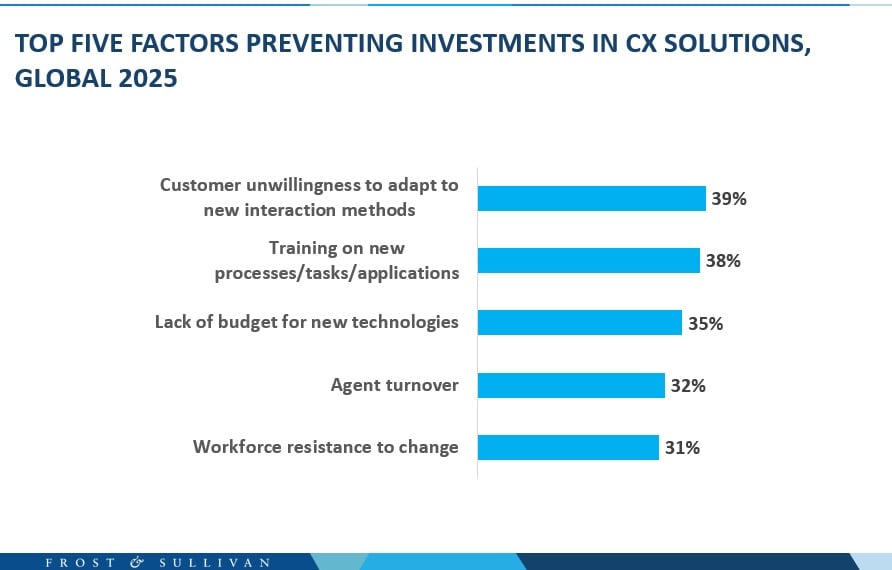
Betts and Stroman shared this quote in their presentation, and I believe it perfectly captures what all businesses need to do to face the AI storm, which has been hitting us with rapid changes every year since 2022. Frost & Sullivan’s recent customer survey of CX leaders illustrates the impact of AI innovation on contact centers worldwide:
Source: FROST & SULLIVAN INC
Without collaboration among all key stakeholders, businesses will be in a state of confusion, unable to successfully leverage the benefits of AI infusion into CX technology.
Alpa Shah, Global Vice President at Frost & Sullivan, has vast professional and volunteer experience in developing business and organization strategies; analyzing product, regional, and vertical markets; planning and executing events; sales and marketing; writing growth opportunity insights; and, most importantly, creating and inspiring teams to be best in class. Her current area of focus is on CX; she has also worked on projects covering technologies such as UC and mobile and wireless.