Most organizations agree that “customer-centricity” is the goal, yet most fail to operationalize the concept because they treat research as a phase rather than a pulse. In this virtual, members-only event, David Massey broke down the operational engine behind UPS’s digital transformation.
Moving beyond the “what” of the case study, the session focused on the “how”… the specific mechanics of moving from quarterly surveys to weekly, sprint-based co-creation. Participants learned how to leverage transparency to reduce friction, how to use “Watch Parties” to align engineering and business silos, and how to track the efficiency metrics that defend your budget.
Action Items
- Accelerate Speed-to-Market: Learn how to replace slow, “check-the-box” feedback loops with a high-velocity sprint engine that drastically reduces development rework
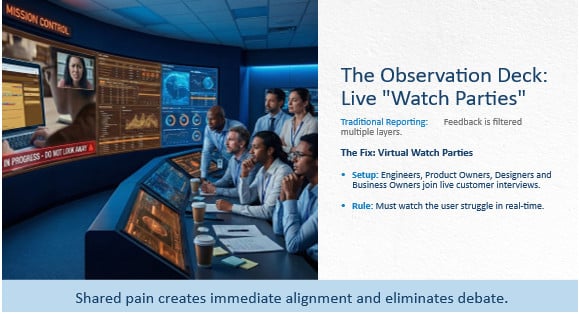
- Break the “Game of Telephone:” Implement strategies like “Virtual Watch Parties” that force engineers, designers, and business leaders to witness user struggles together in real-time
- Track Metrics That Defend Budget: Move beyond vanity scores to track the hard ROI of effortless experiences, focusing on development efficiency, support reduction, and conversion impact
David Massey, Director of Product, Head of Research, Experimentation and Personalization at UPS, began the virtual event by noting that he would be sharing highlights of his journey helping to build a new operational playbook at UPS, successfully redesigning the customer experience. His presentation included guidelines for building continuous, meaningful dialogue with customers, with the end goal of improving their experiences and changing inefficient organizational processes.
As noted, many companies claim to offer their customers “effortless experiences” but few truly achieve it. When it comes to customer service, many organizations still rely on dated, largely ineffective practices like periodic check-ins or quarterly surveys, often administered way too late to resolve issues. As UPS discovered, it’s much better to build a business where stakeholders listen to customers on a regular basis, adapt to their needs, and address their issues in a timely manner.
Moving from Long-Term to Real-Time
Massey outlined a process to help customer contact leaders shift their thinking and actions from a long-term “project phases” mindset to a continuous, “pulse-taking” approach to customer service. The key steps – Prototype-Pulse-Synthesize and Iterate, are described in the graphic below:
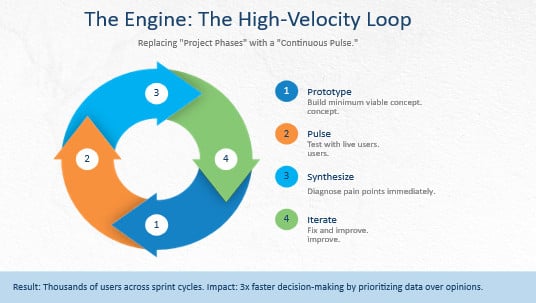
As discussed, conducting customer research does not need to be a lengthy process. Start with a minimum viable concept and then “pulse test” it with users and customers. There are AI tools that can assist with these discussions. Next steps include synthesizing the feedback and pinpointing customer pain points. Try to really understand and hear what your customers are saying. It may not be what you want to hear. Finally, iterate, fix and improve issues and plan on continuously repeating the process. Act on the data accrued.
UPS leveraged the above approach at scale and successfully re-designed the small business shipping experience for their customers. Teams consisting of product leaders, engineers, marketers and others spoke to or listened to thousands of customers in a matter of weeks via real-time, moderated interviews or surveys. This approach allowed them to move three times faster from concept to production than previously. In addition to making enterprise operations more efficient, the customer feedback helped teams ensure that they were on track with products, processes, and experiences. It also helped to align teams.
Key Transformation Takeaways
In addition to outlining the process changes UPS made, Massey shared some key insights and lessons learned along the journey. Top takeaways included:
- Strive to minimize or eliminate customer friction and cognitive overload; make it easy/easier for your customers to do business with you
- Give pertinent product and billing information and set realistic expectations – but don’t overdo it
- Example: UPS found that 77% of customers wanted to review details before payment
- But 69% preferred rough estimates for speedier service – they didn’t need every single detail before shipping, just a realistic estimate
- Design experiences that help you understand how your customers really feel
- Be prepared for at least some of your assumptions to be incorrect
- Talking to your customers can help you understand the why of their behaviors – something that surveys rarely accomplish
Final Thoughts
In closing, Massey made clear that he was presenting a simplified version of the processes and playbook UPS leveraged. He also emphasized the importance of showing the value of a good customer experience and tracking metrics that contribute to the bottom line, such as call deflection, conversion rates and incremental revenue. He encouraged CX executives to defend their budgets and share good results with leadership. This is particularly important in the customer contact space, which is not traditionally recognized as a profit center.
David Massey has spearheaded customer-centric digital transformation for over two decades, pioneering UPS’s Experience Design revolution through data-driven optimization. As a digital transformation leader, he established UPS’s first customer co-creation programs that significantly improved digital experiences on ups.com and across UPS’s global digital ecosystem spanning 225 countries in 38 languages, directly contributing to substantial business growth and enhanced customer satisfaction.